
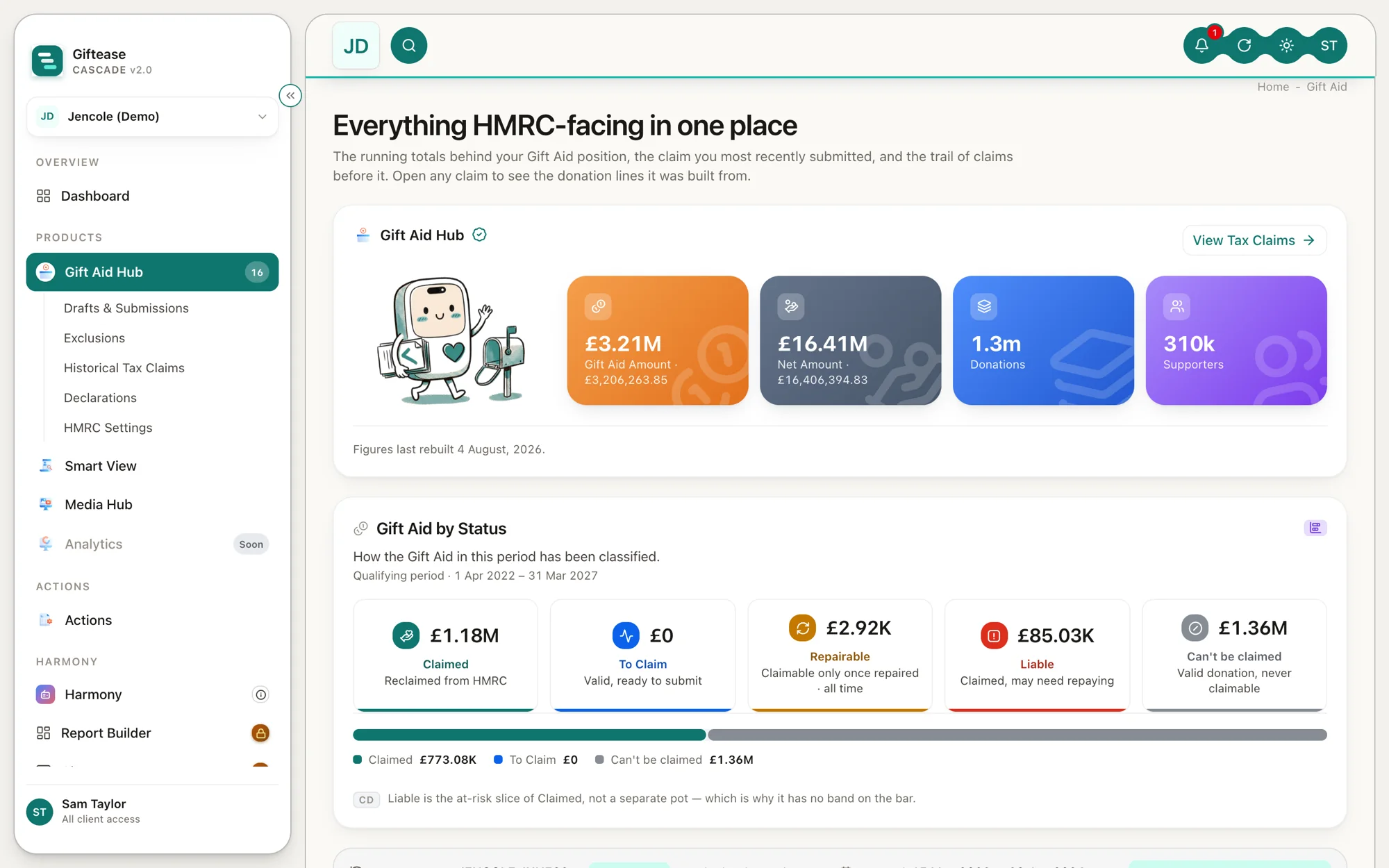
The money is in your data. Cascade finds it.


Much of your Gift Aid is already in your records. Finding it is the work.
Many charities hold Gift Aid they cannot claim: a declaration that never made it onto the right record, a supporter who gave for years without one, a retrospective claim no one had time to build. Cascade shows you the full picture.
Is this you?
Charities come to us at a few recognisable moments. If one sounds like yours, we’ve been there with you.
Something surfaced you couldn't explain, and stopping felt safer.
More detail
It's the most common reason charities call us, and the most fixable. You can hold back what worries you and keep claiming on everything else.
The process looked daunting, or it lives in one person's spreadsheet.
More detail
Newer and smaller charities either leave Gift Aid alone or run it through spreadsheets only one person understands. Neither is a reason to leave eligible Gift Aid unclaimed.
Several CRMs, branches, retail, or history that never reconciled.
More detail
Several CRMs, affiliated or federated charities, retail alongside fundraising, or years of donation history that never quite reconciled. Complexity is where Gift Aid goes missing, and it's what Cascade was built for.
You're confident today, but older data may hold more.
More detail
Usually there is Gift Aid sitting in older data that never made it into a claim. You can claim up to 4 years after the end of the financial period each gift fell in, so there is usually still time to recover it.
One click from the record.
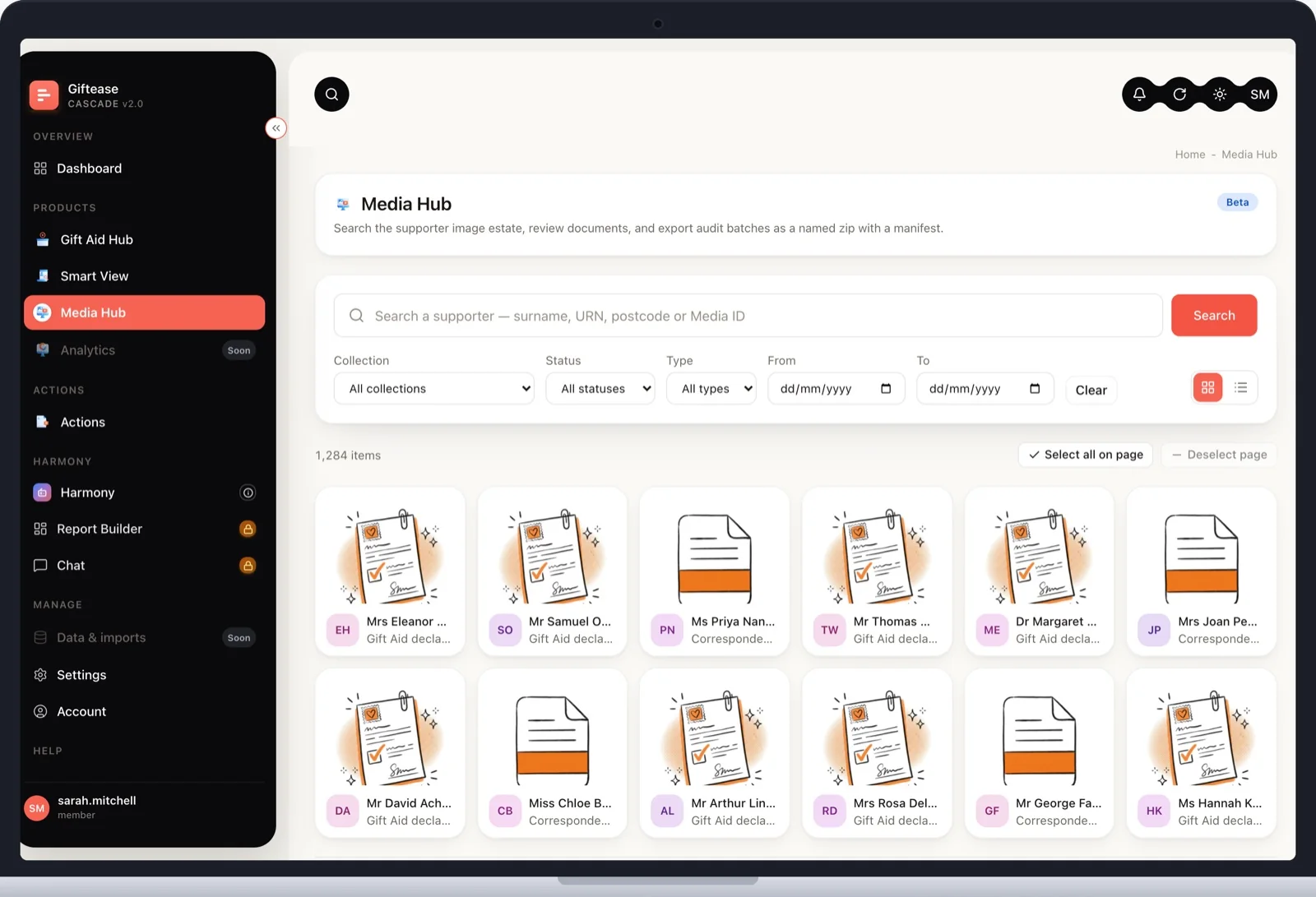
When HMRC queries a claim, you need the declaration, the gift and the original document. Cascade keeps them together.
Search by name or supporter reference. Every gift on one screen: what has been claimed, what is eligible, where the declaration sits. Save the views you use most.

Media Hub files scans and correspondence against the supporter they belong to. A declaration opens from a claim line.
Every query raised against the record it concerns. Tracked through logged, in review, applied and resolved.

The figure on your dashboard and the figure in your board pack are the same figure. Split your supporters any way you like, click any figure to see the gifts behind it, and track how each year's new donors keep giving.
Built-in RFM. Cascade ranks supporters by how recently, how often and how much they give, so you can target your first-time, active and warm supporters and see what each segment is worth.

From draft to HMRC receipt.
Four steps, all in one place. No spreadsheet in the middle.
Pick a date range; the claim assembles itself.
More detail
Every donation that passes Cascade’s checks against HMRC’s rules, minus anything your own exclusions hold back, grouped by tax year, in seconds. Draft as many as you like: nothing is committed until you send it, so you can fix data, rerun and compare.
See what was left out, and why, before anything leaves.
More detail
Down to the individual donation line. Open a line to reach the supporter, the declaration behind them and the rule that made the call. It's the pre-submission audit that used to mean a week of sampling.
Filed with HMRC, with a receipt on the same screen.
More detail
The claim is checked against HMRC's current format, then filed through HMRC's own service. A receipt ID comes back on the screen you filed from, and the claim stays in your history to reopen, inspect line by line, or export.
Any rejected lines come back in plain English, with a fix.
More detail
Rejects and queries return line by line, the reason written in plain English and a fix suggested: a missing house number, a postcode in the wrong format, a donation date outside the claim period. One click sends the line to Actions with an owner against it.
Hold back what worries you. Keep claiming the rest.
Most charities that come to us are worried about what they've already claimed, and the safest thing they can think of is to stop. An exclusion is a third option: a rule that holds a donation back from a claim, with the reason recorded, while everything you're confident in keeps going.
More detail
The rules everyone needs. Age of donation, declaration validity, whether the donor can be identified, and non-qualifying income: applied the same way every time and recorded, so an auditor sees the test each donation passed.
The rules built for you. Block a date range you can't vouch for, a payment type, a fund, a source, or addresses you know are test data. If you can describe what worries you, we can fence it off.
Ranked by what it costs. Every rule shows the Gift Aid it's holding back and the supporters behind it, so you work the biggest one first. Fix a record and it flows back into the next claim.
Trends. If a rule suddenly catches more supporters than last month, something has changed in how data is arriving. You find out when it happens, not when it costs you a claim.
A tidy piece of admin, by someone doing their job properly. The next claim excluded that supporter, and the first thought was: have we been claiming against a joint record for years?
What happened next
The answer was in the record's history. On the date of every past claim it was an individual's record. It only became joint, where you can no longer tell which person is the taxpayer, after the title changed. So the past claims were valid, and we could prove it as the record stood on the day it mattered.
The next claim is the one that would have been wrong. Without the exclusion, it would have gone out on a joint record. Nobody did anything wrong, no CRM flagged it, and no person would have found it.
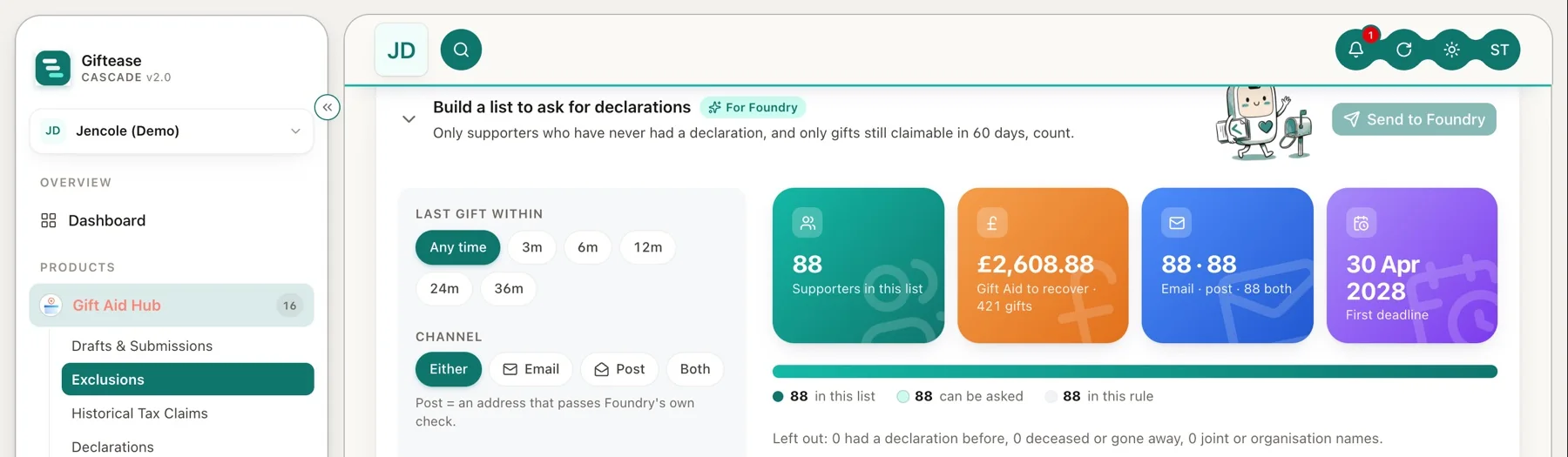
The Gift Aid waiting behind supporters who never declared.
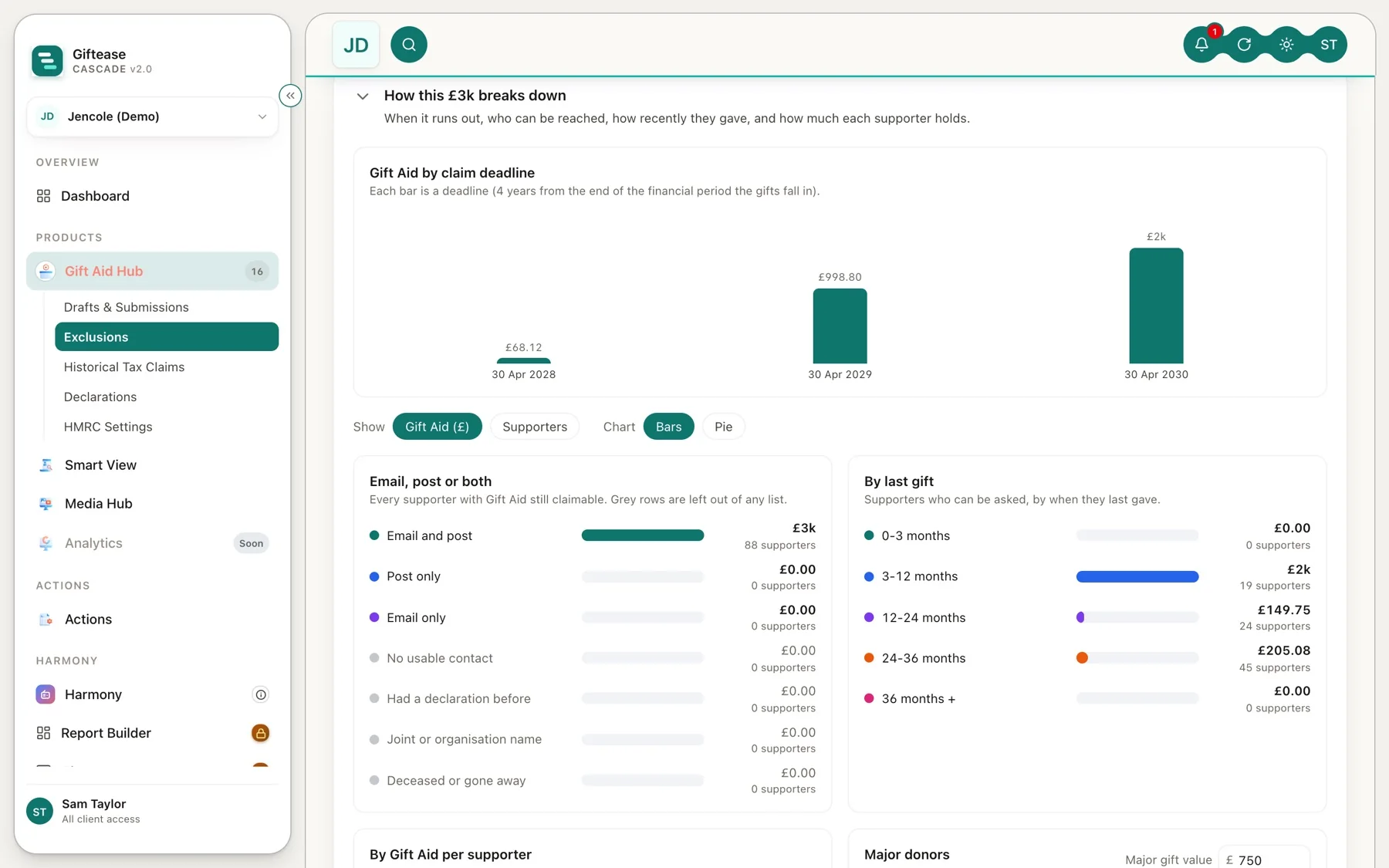
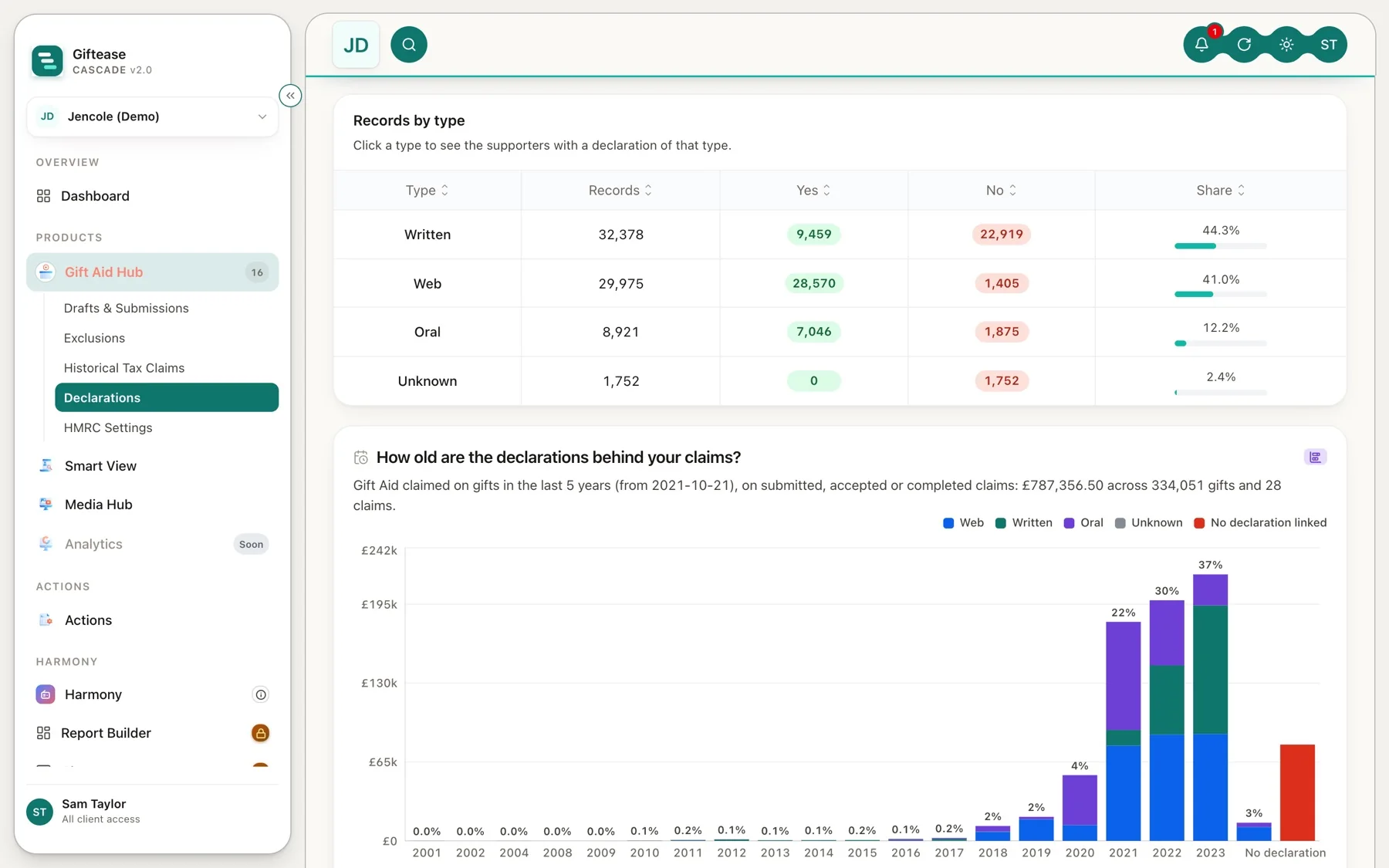
Cascade shows every supporter who has given without ever making a Gift Aid declaration, and how much eligible Gift Aid is still claimable on their gifts.
Every supporter's Gift Aid status, today.
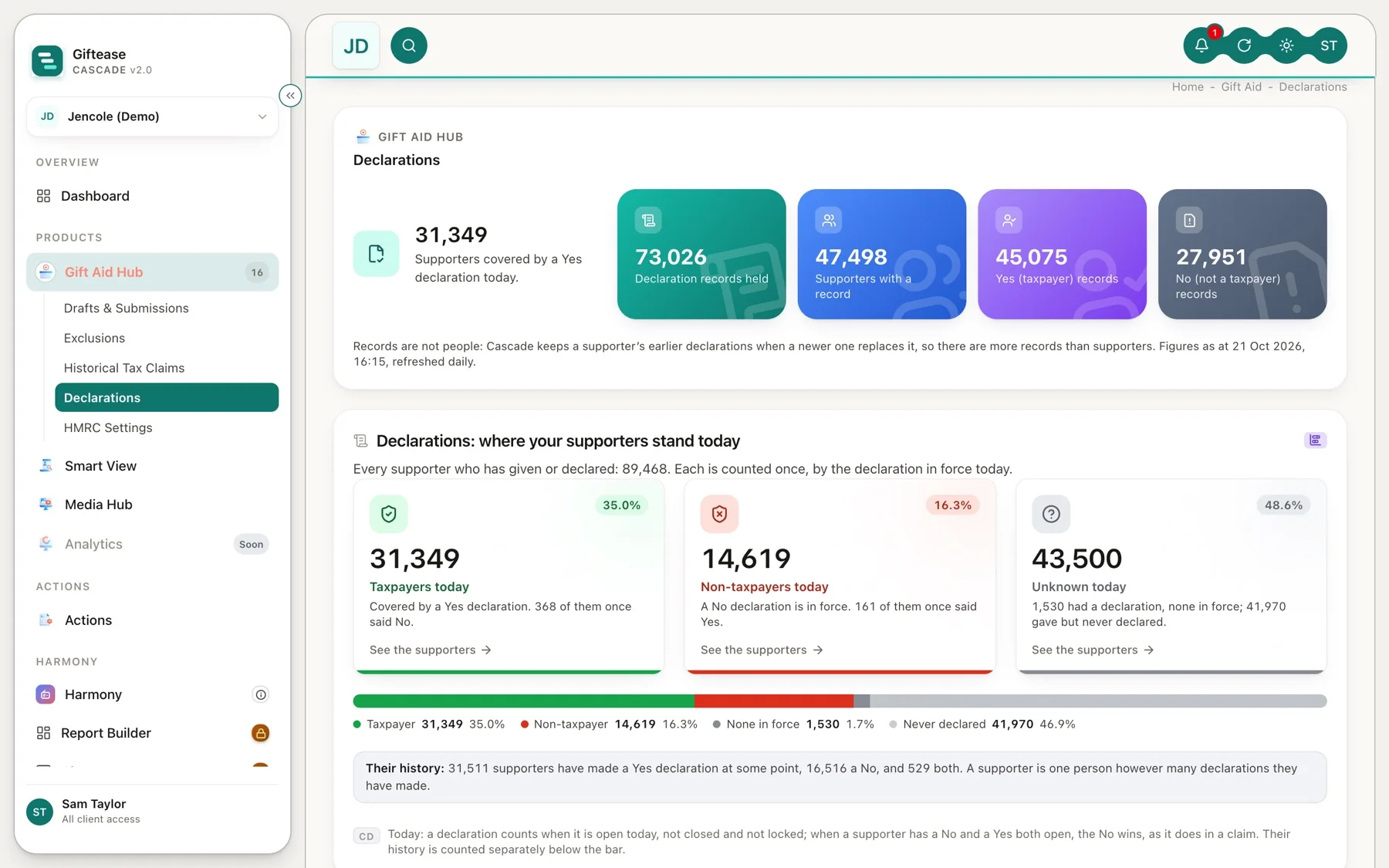
Gift Aid depends on the declaration in force on the day. Cascade shows where every supporter stands now, and the declarations behind it.







Built on 22 years in Gift Aid.
Our team has 22 years inside UK Gift Aid. The edge cases, the schedule changes, the HMRC queries: we have seen them. That experience is built into Cascade, not left in a manual.

Cascade finds it. Foundry unlocks it.
Cascade tells you which supporters could add Gift Aid to their gifts. Foundry reaches them with a letter, a QR code and a few short screens. No paper to return. Declarations land back against the record they belong to. The claim follows.
Every eligible gift is worth more to your charity once the supporter declares, if they pay enough UK tax. Cascade finds the gifts. Foundry gets the declaration.
See how Foundry works →
Let's talk.
Cascade is available today, and it starts with a conversation. Tell us about your claims and your data, and we'll walk you through the Gift Aid Hub, Smart View, Media Hub and Actions on a working account. No commitment.