Exclusions

Every rule holding your Gift Aid back, named, quantified and ranked. Claim again in days on what you know is good, while everything you are unsure about sits safely outside the claim.

Talk to us
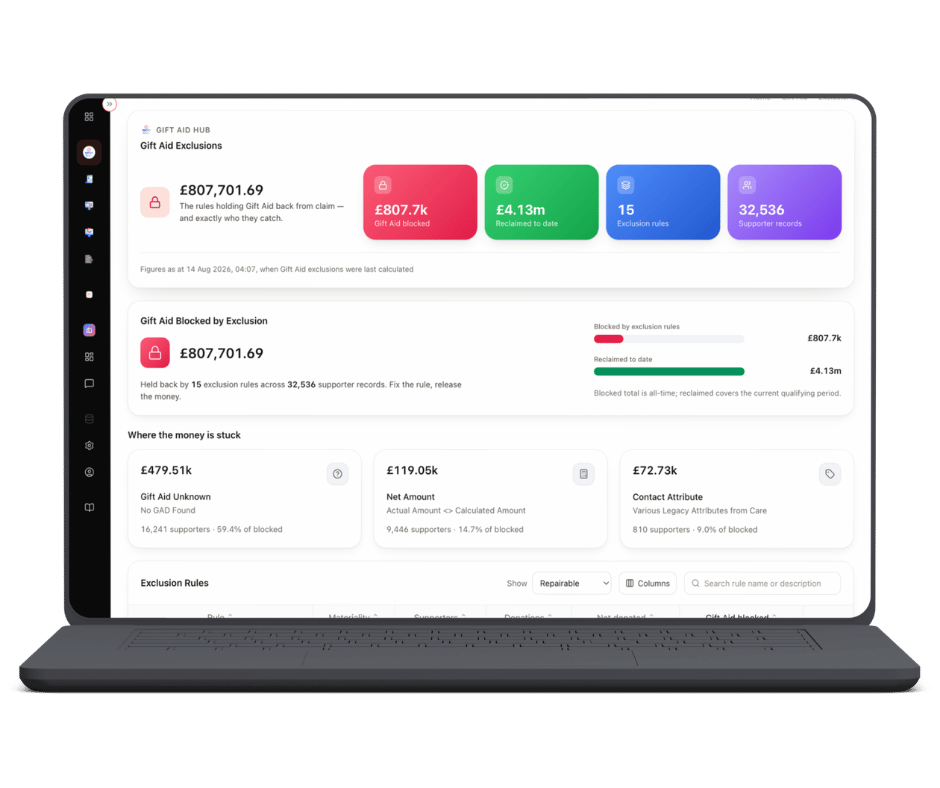
The Gift Aid Hub screen in Cascade 2.0, showing donations sorted into claimed, ready to claim and repairable
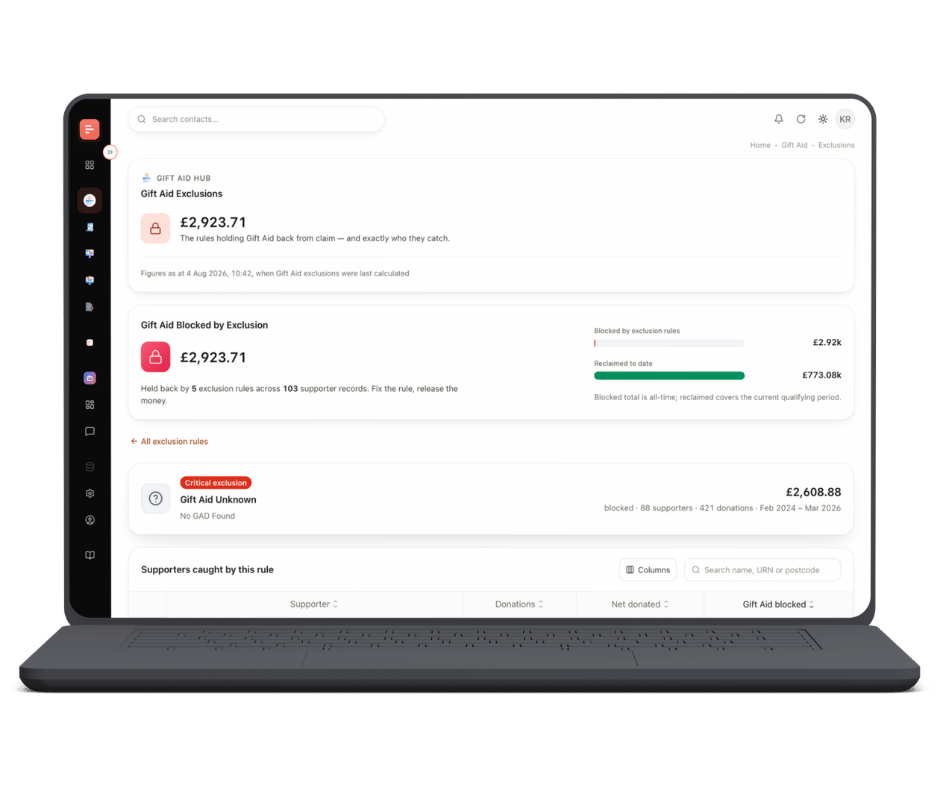
An exclusion rule in Cascade 2.0 drilled down to the individual supporters it is holding back from a claim

The idea

Stop claiming on everything, or stop claiming at all β€” those were your only two options

Most charities that come to us are not looking to increase their Gift Aid. They are worried about what they have already claimed, and the safest thing they can think of is to stop.

An exclusion gives you a third option. It is a rule that holds a donation back from a claim, with the reason recorded. Anything you are unsure about sits behind it, out of the claim and safe, while everything you are confident in keeps going.

You are claiming again in days, and you have not touched a single record you were worried about.

How it works

Standard rules, and rules built for you

Every charity gets the standard rules that keep a claim compliant. What makes the difference is the second kind — the ones we write for the specific thing your team is worried about.

The rules everyone needs

Age of donation, declaration validity, donor identifiability and non-qualifying income. The baseline that keeps a claim compliant, applied consistently and recorded every time β€” so an auditor sees not only what you claimed, but the test each donation passed first.

The rules built for you

Block a date range you cannot vouch for. Block a payment type, a fund, a source, or the addresses you know are test data. Block where a split amount stopped matching the donation after a bad import. Rules are written against your own data, so if you can describe it, it can be a rule.

Ranked by what it costs

Every rule carries the Gift Aid it is holding back and the supporters sitting behind it, scored critical, significant or minor. You work the one worth Β£480,000 before the one worth Β£1,500 β€” and you can see whether a rule is catching more this month than it did last.

The register

Every rule, and exactly what it is holding

One screen shows the total Gift Aid held back from claim, the rules holding it, and the supporters behind each one.

Not β€œyour data has problems”. Rule by rule, in pounds and in people, so it reads as a work queue rather than a diagnosis.

  • Total blocked, next to total reclaimed to date
  • Each rule with its value, supporter count and donation count
  • Critical, significant or minor by share of the money
  • Drill from any rule straight to the people it caught

The list

Repair at your pace, with no risk to what you are claiming

Behind every rule is a curated list of the supporters it caught. View it, download it, work it in whatever order suits you.

Because the exclusion is doing the protecting, nothing you fix can put a live claim at risk β€” and nothing you have not got to yet is quietly creeping into one. Fix a record and it flows back into claim on the next rebuild.

Some charities work the list themselves. Some ask us to. Either is fine, and it is a separate conversation from getting you claiming again.

Trends

When a rule starts catching more, something upstream has changed

Every exclusion carries a direction of travel. A rule that suddenly catches more supporters than it did last month is telling you something that has nothing to do with Gift Aid.

If your address exclusions are rising, addresses are arriving differently. If a title rule starts firing, someone has changed how records are being updated. You find out when it happens, not when it costs you a claim.

Most data quality tools tell you a percentage. We tell you the pounds.

What people ask about exclusions

Does excluding donations mean we claim less?

Read more about Does excluding donations mean we claim less?

In the short term you claim on less than your total income, yes β€” but you claim, which beats stopping. And almost every charity we work with ends up claiming more than before, because the exclusions make it safe to go after the money that was previously written off.

How quickly can we be claiming again?

Read more about How quickly can we be claiming again?

Days rather than months. The rules are the fast part. Reconciling historic data is the slow part, and the whole point of an exclusion is that you do not have to wait for it.

Can you build a rule for our specific problem?

Read more about Can you build a rule for our specific problem?

Almost certainly. Exclusions are expressed against your data, so if you can describe the population you are unsure about β€” a date range, a payment type, a source, a fund, an attribute, or a combination β€” it can be a rule.

What happens to the excluded donations?

Read more about What happens to the excluded donations?

Nothing is deleted and nothing is lost. They sit outside the claim with the reason recorded, on a list you can work through. Repair a record and it becomes claimable again at the next rebuild, within the normal HMRC time limits.

What if we do not want to change a record?

Read more about What if we do not want to change a record?

That is a legitimate answer. The exclusion keeps blocking it, and we will tell you what to note on the record in your own CRM so the next person to look has the explanation without having to ask you.

Search
Menu