
Living data intelligence · Harmony

Harmony is an engine, not a chatbot. Ask a question of your data in plain English and the answer comes back as a frame — a living analysis you can drill, branch, compare against three others at once, and reopen exactly as it stood. If your data is already on Cascade, Harmony can read it today.
Book a demo
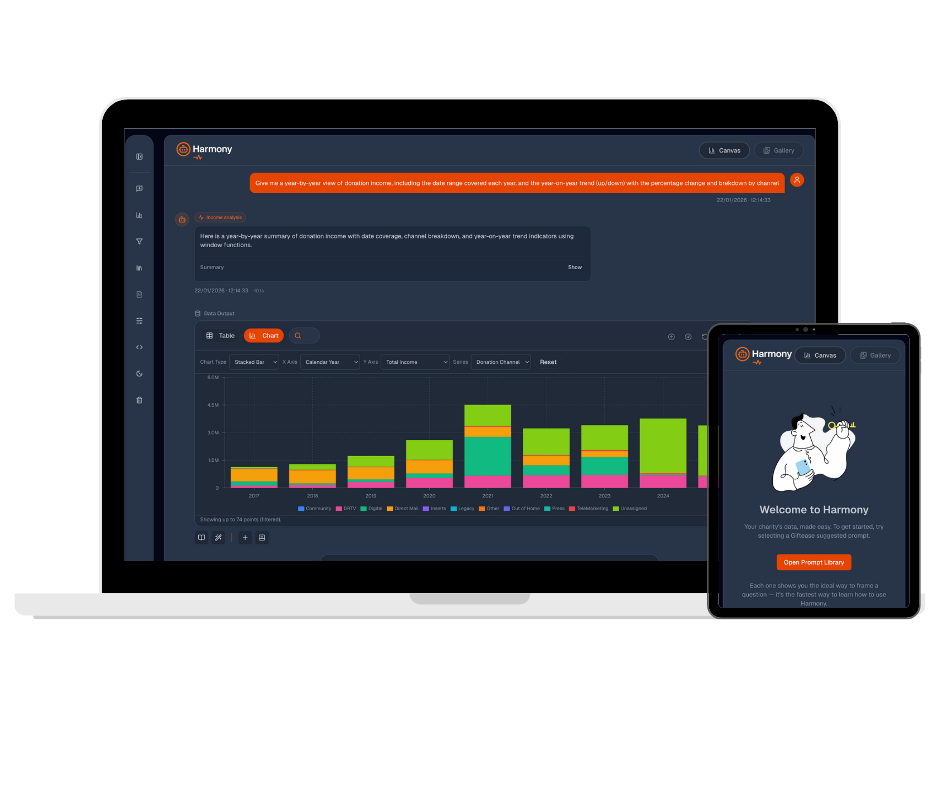
Harmony shown on a laptop and tablet, answering a question in plain English with charts

Living data intelligence

Ask anything. The answer stays alive.

Harmony is an engine, not a chatbot. You ask a question of your data in plain English and the answer comes back as a frame — a living analysis you can drill into, branch from, compare against another, and reopen months later exactly as it stood.

Most tools hand you a number and forget it. Harmony keeps it.

Analytics and Harmony

One answers the questions you expected. The other answers the ones you did not.

Every Cascade client asks this first, so it is worth being blunt about it.

Analytics is built in advance

Analytics gives you reports somebody designed before you had the question — income by channel, claims by status, supporters by segment. They are fast, governed and dependable, and they answer what you already knew you would need to ask.

Harmony is built at the moment you ask

Harmony has nothing pre-built. You ask, and it composes the answer — a chart, a map, a table, a card — then lets you keep going. And when an answer turns out to be one you want every month, it can become a report. Analytics is what Harmony produces once you know what matters.

Powered by Frame Technology

The idea

A frame is an answer that does not get thrown away

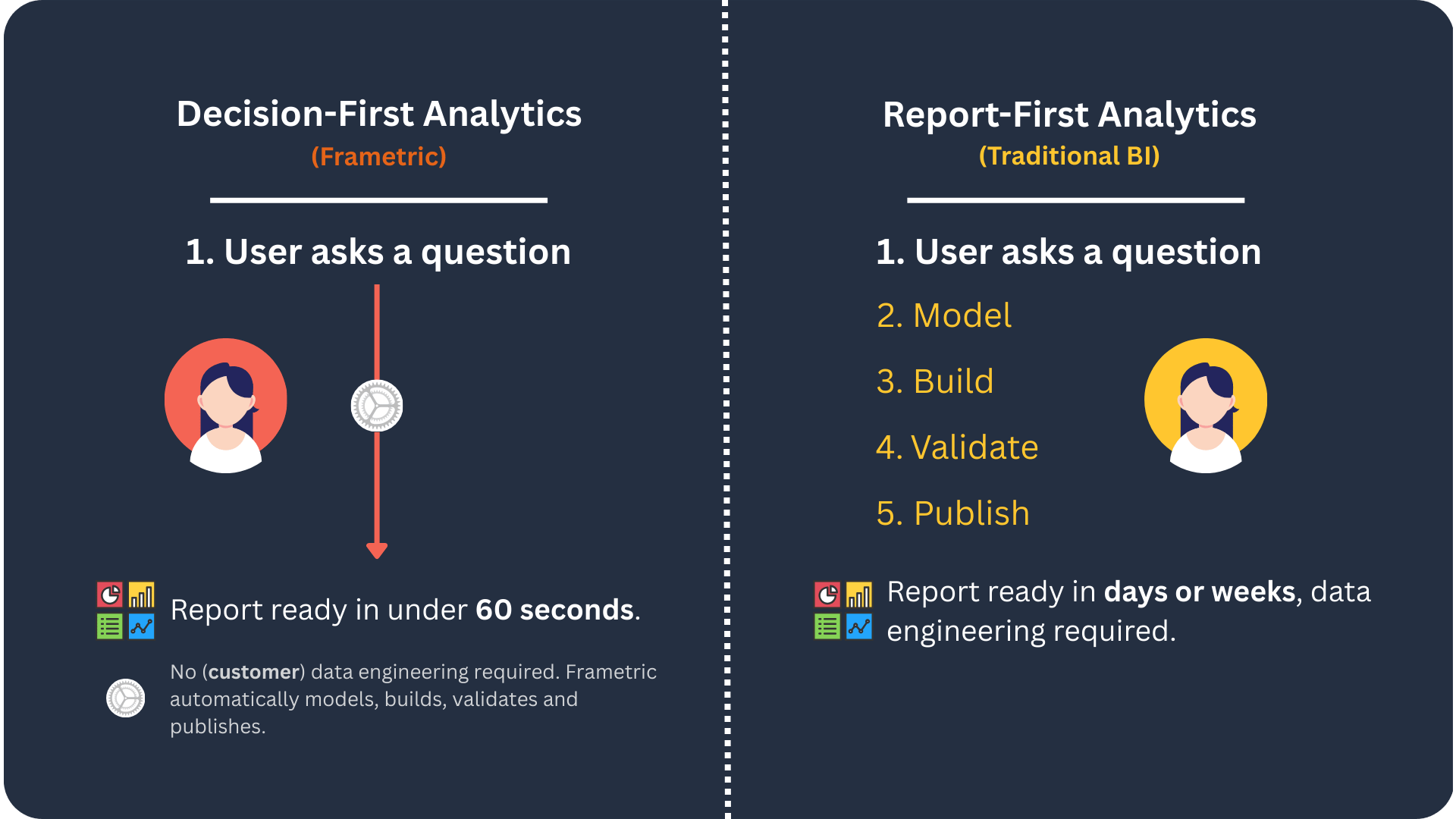
Ask a normal reporting tool a question and you get output. Ask it again next month and it runs again from nothing, costs again, and can quietly answer differently.

In Harmony the answer becomes an object. It holds the question, the working and the result, so it can be reopened, drilled, branched into follow-ups, compared with another frame, or handed to a colleague who sees exactly what you saw. Ask the same thing a year later and you get the same answer, because it is the same frame.

The engine that does this is Frame Technology. Analytics runs on it too, which is why the two products cannot disagree — they are two surfaces on one engine.

That is the whole product. Everything below is what becomes possible once answers stop being disposable.

How it works

What using Harmony actually looks like

No dashboard to commission, no query to write, and nothing to build first. You ask, and then you keep going for as long as the question is interesting.

Book a demo
1

Ask in plain English

Type the question the way you would say it to a colleague. Harmony works out what you meant against your own modelled data, and answers with whatever fits — a chart, a map, a table, a card, or a sentence.

2

Drill without starting again

Break a year into quarters, pull one channel out on its own, follow a region down to a postcode. The whole analysis follows you down, headline figures included. Come back up and it is instant.

3

Branch into the next question

A good answer usually produces a better question. Branch from where you are rather than going back to the beginning, and keep the trail of how you got there.

4

Save it, and reopen it whenever

Keep the frame. Reopen it next quarter and it is exactly as you left it, against data that has moved on — or as it stood the day you first asked.

Four Harmony frames side by side in Canvas, being drilled in sync

Canvas

Four answers. One drill. In sync.

Put up to four living frames side by side — last year against this one, region against region, campaign against campaign, one scenario against another.

Drill into one and all four move together. Then ask, in plain English, what changed and why.

Compare anything to anything

Periods, segments, campaigns, scenarios. If two things can be asked about separately, they can be put next to each other and drilled together.

Time travel your numbers

See any analysis exactly as it stood at any point in the past, not as it would be recalculated today. That record is the part nobody else keeps — and it is what makes “what changed?” a question with an answer.

If you are on Cascade

Your data is already where Harmony needs it

This is the part that surprises people. There is no migration, no warehouse project and no integration to scope. Once your donations, declarations, supporters and claims are loaded into Cascade, Harmony can read them — because it reads the same governed model every other Cascade product reads.

It is a separate product with its own home, bought separately. But switching it on for an existing Cascade client is a matter of enabling it, not building anything.

Tested past ten million transactions in a single dataset, on the same platform your Cascade data already sits on.

Why the answer holds up

Every figure carries a receipt

Each chart tells you where its numbers came from. When someone in the room asks how you got that, the working is already on the page.

No AI in the drill path

The engine that produces your figures is deterministic. AI helps interpret the question; it never invents the answer. Ask the same thing twice and you get the same number twice.

It does not care which CRM you run

Harmony reads the canonical Cascade model, not your CRM's tables. What matters is that your data is loaded, not where it came from.

One governed model underneath

One definition of a supporter, one of a gift, one of Gift Aid eligibility — the same model Analytics and the Gift Aid Hub read. Definitions live in one place instead of three.

Near-live, not last month's extract

Answers come off your operational data, refreshed on a schedule rather than rebuilt by hand. Fresh enough to act on this week.

Built for the size you actually are

Tested past ten million transactions in a single dataset. A drilled answer returns in seconds, not overnight, and it does not slow down because your history got longer.

Read-only, by design

Harmony reads your data and nothing more. It cannot write back to Cascade or to your CRM, so exploring a question carries no risk to the record.

Bring a question we cannot rehearse

The quickest way to judge Harmony is to arrive with the question your last board meeting could not settle, and watch us follow it down through your own income.

Book a demo

What we do with your data, and what we never will

Harmony reads. It does not write, and it does not learn from you. Charities ask us this before anything else, so it is worth being exact about it.

1

Your data does not train Harmony

What Harmony understands comes from the modelled structure of Cascade — what a supporter is, what a gift is, how Gift Aid eligibility is decided. It does not come from reading your records, now or at any point later.

2

It does not train anything else either

Your data has never been used to develop, test or improve any other model, ours or a third party’s. It stays inside your environment rather than being pooled with anyone else’s.

3

Used for you, and for nothing else

Harmony cannot write back to Cascade or to your CRM. We do not share your data, sell it, or repurpose it for any use beyond answering your organisation’s own questions.

What is in it today

What you can ask about

Answers come back in whatever form suits the question — charts, maps, tables, cards or a plain sentence — and every one of them can be drilled, branched and kept.

Harmony answers on the same modelled data the rest of Cascade runs on: your income and giving, your Gift Aid claims, your supporters and campaigns, and the record of work done against them.

Income Manager is the first full report — income by channel and by year, drillable down to the day, with custom income channels where your CRM’s own fields were never reliable. Others follow the same pattern, and because they are built on the modelled layer rather than assembled by hand, a new measure arrives without anybody rebuilding a dashboard.

Harmony runs against your own analytics warehouse, so switching it on depends on your data being loaded. Some organisations are live now and others are queued — ask us where yours sits.

Ask about your data

Harmony updates, when there is something worth reading

Occasional notes on what has shipped in Harmony and what is coming next, written for people running Gift Aid rather than for people buying software. No campaign sequence, and you can leave at any point.

LinkedIn
Follow us on LinkedIn

Agree to privacy policy(Required)

Worth half an hour

Whether you run fundraising, finance or the data behind both, the test is the same: bring the question that took three people and a spreadsheet to answer last quarter, and see how far down we can follow it in one sitting.

On your own income, not a sample set. A short conversation, no pitch.

Book a demo

Questions charities actually ask

How is Harmony different from Analytics?

Read more about How is Harmony different from Analytics?

Analytics is built in advance: reports designed before you had the question, fast and governed, answering what you already knew you would ask. Harmony has nothing pre-built — you ask, and it composes the answer, then lets you drill, branch and compare from there.

They read the same governed model, so they cannot disagree. And when a Harmony answer turns out to be one you want every month, it can become a report — which is to say Analytics is often what Harmony produces once you know what matters.

Is Harmony part of Cascade, or a separate product?

Read more about Is Harmony part of Cascade, or a separate product?

Separate. Harmony has its own surface and its own home; the link in the Cascade portal sidebar takes you out to it rather than opening a panel inside the portal.

What it shares with Cascade is everything underneath — the same canonical data model and the same reporting engine. So it is a distinct product to buy and to use, built on the same foundation as the reporting you already have.

Can Harmony make a number up?

Read more about Can Harmony make a number up?

No. There is no AI anywhere in the path that produces your figures — the engine is deterministic, so the same question against the same data returns the same answer every time.

On top of that, every chart carries a record of exactly where its numbers came from. If a figure looks wrong, you can see what produced it rather than having to take it on trust.

Will Harmony's numbers agree with the ones in Cascade?

Read more about Will Harmony's numbers agree with the ones in Cascade?

Yes, and that is the main reason it was built this way. Every product reads one canonical model — one definition of a supporter, one of a gift, one of Gift Aid eligibility — and Harmony runs the same engine as the reporting inside Cascade.

This used to be the hard part. Dashboards, exports and board reports each computed things their own way and quietly drifted apart. Now a report cannot disagree with itself across two products, because there is only one set of definitions to disagree about.

Do we need SQL, a data team, or a new dashboard built first?

Read more about Do we need SQL, a data team, or a new dashboard built first?

None of the three. You start from a report that already exists and drill it — right-click a year to break it into quarters, or pull out a single channel. There is nothing to write and nothing to commission.

This matters most for the charities with no analyst at all. The reason questions go unanswered is usually not that the data is missing; it is that asking costs a fortnight of somebody’s time.

How current is the data?

Read more about How current is the data?

Near-live. Harmony answers from your analytics warehouse, which is refreshed on a schedule against your operational systems rather than synced continuously.

Continuous sync sounds better than it is: it costs a great deal and almost no Gift Aid or fundraising decision turns on the last few hours. Scheduled refresh is fresh enough to act on this week, and it is what keeps the platform affordable for charities. We will confirm the refresh cadence for your organisation as part of setting you up.

What can we ask about today?

Read more about What can we ask about today?

Your income and giving, your Gift Aid claims, your supporters and campaigns, and the record of work done against them — the same modelled data the rest of Cascade runs on.

Income Manager is the first full report: income by channel and by year, drillable down to the day, including the custom income channels we build during your data load — community, digital, DRTV, direct mail and the rest — rather than the half-filled fields your CRM offers. More reports follow on the same model.

Which CRM do we need to be on?

Read more about Which CRM do we need to be on?

Any of them. Harmony reads the canonical Cascade model rather than your CRM’s tables, so the question is whether your data is loaded into Cascade, not which system it came from.

Cascade already takes data from more than a dozen CRMs and third-party sources — and not only CRMs, but online donation platforms, event and ticketing systems, flat files and Gift Aid claim data. Setting up a system we have not seen before takes a piece of configuration work; tell us what you run and we will tell you what is involved.

Who in our team can see what?

Read more about Who in our team can see what?

Access is controlled at the row, not just at the screen. The canonical model carries row-level access rules and a full audit of who read what, which is what makes it safe to open reporting up beyond the two or three people who currently hold the keys.

In practice that means a regional fundraiser can be given their own region and nothing else, and finance can be given the money without supporter-level detail, from the same reports.

What does it take to switch Harmony on for us?

Read more about What does it take to switch Harmony on for us?

Your data needs to be loaded into your own analytics warehouse first. Where that is already done, Harmony is available now; where it is not, you join the rollout queue and we will be straight with you about timing.

The fastest way to find out where you stand is to show us what systems you hold data in. That conversation takes about half an hour and tells you more than any amount of reading.

Harmony is priced separately

Talk to us
Search
Menu